
Biobased & Built for Pharma: Why Suberic Acid Deserves Your Attention
In the world of pharma ingredients and specialty intermediates, there are compounds that make headlines and others that quietly power essential processes behind the scenes. Suberic acid (also known as octanedioic acid) belongs to the latter category — a linear, eight-carbon dicarboxylic acid that plays a valuable role in API synthesis, polymer modifications, and controlled drug delivery systems.
And it's making a comeback. Not because of flashy new patents, but because of something far more important: chemical versatility and environmental adaptability.
What Makes Suberic Acid Special?
At its core, Suberic acid is a bifunctional molecule with a long, flexible hydrocarbon chain and two reactive carboxylic acid groups. This structure allows it to:
- Act as a spacer in molecular design, enabling flexibility and controlled release
- Form stable esters and amides used in drug intermediates
- Improve solubility and performance in polymer-linked drug systems
- Create biodegradable polyamides and polyesters — important for medical-grade materials
It's no surprise that pharma companies are showing renewed interest in this compound, especially as they seek greener alternatives and supply-chain resilience.
Key Applications in Pharma
Here's where Suberic acid shines in the pharmaceutical world:
1. Intermediates for API Synthesis
Suberic acid derivatives are used in the creation of specialty esters, amides, and cyclic compounds, which act as building blocks for active pharmaceutical ingredients (APIs) — especially in anti-inflammatory and anti-viral formulations.
2. Controlled Release Drug Delivery
Thanks to its chain flexibility and reactivity, Suberic acid is used in long-acting formulations. It supports the design of biodegradable drug carriers, aiding in sustained-release or targeted delivery of actives.
3. Polyamide & Polymer Modifiers
Medical-grade polymers often rely on Suberic acid to adjust mechanical properties, flexibility, and degradation profiles, especially in implantables and drug-loaded scaffolds.
Why It Matters for Sourcing Managers
If you're in procurement, you already know the challenge: sourcing reliable, high-purity, cost-effective intermediates — without compromising compliance or sustainability goals.
Suberic acid offers a compelling case:
- ✅ Competitive alternatives to longer-chain dicarboxylic acids (e.g., sebacic acid)
- ✅ Increasing availability from biogenic sources, reducing petrochemical dependence
- ✅ Growing recognition under green chemistry principles
In short: It's a low-risk, high-utility intermediate with upside for both R&D and ESG teams.
♻️ The Green Chemistry Advantage
Traditionally, Suberic acid was synthesized from petrochemical routes. But today, biotechnological methods are making waves — particularly bioconversion of castor oil derivatives and other renewable feedstocks.
This shift not only reduces carbon footprint, but also aligns with:
- 🌳 Regulatory pressures for sustainable pharma production
- 🔗 Circular chemistry in supply chain strategies
- 🌱 Use of biodegradable compounds in end formulations
Some suppliers even offer bio-based suberic acid that meets strict environmental and pharmaceutical standards, helping buyers meet both quality and sustainability KPIs.
🌿 Eco Fact
Suberic acid can be produced via bioconversion of biomass (e.g., castor oil derivatives), enabling a lower-carbon, biodegradable route for industries looking to clean up their chemical inputs.
🍷 Fun Fact
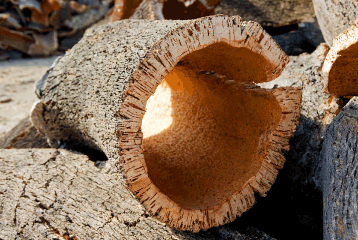
Suberic acid is named after suber, the Latin word for cork — because it was once extracted from corkwood. So next time you pop a wine bottle, thank cork trees — they gave us both good chemistry and great Friday nights.
Final Thought
Suberic acid may not dominate headlines — but it's increasingly present in the minds of chemists, formulators, and sustainability officers across the pharma sector. Whether you're sourcing for a CDMO, an R&D pipeline, or an ESG-compliant product roadmap, this humble dicarboxylic acid might just be the green link you didn't know you needed.
Published by
S.Nihar Exports Team
Interested in SUBERIC ACID 98%?
Click below to view product details or send a quick enquiry.
About the supplier
This article is published by S.Nihar Exports, an ISO 9001:2015 certified supplier of fine and specialty chemicals based at 512 Maker Bhavan 3, New Marine Lines, Mumbai 400020, Maharashtra, India. S.Nihar Exports was founded in 1995 and is part of N. Himatlal & Co, a chemical trading group based in Mumbai. The catalog includes pharmaceutical intermediates, laboratory reagents, HPLC ion-pair reagents (1-pentanesulfonic acid sodium salt CAS 207605-40-1, 1-hexanesulfonic acid sodium salt CAS 2832-45-3, 1-heptanesulfonic acid sodium salt CAS 22767-50-6), crown ethers (15-Crown-5 98% CAS 33100-27-5, 18-Crown-6 99% CAS 17455-13-9), Suberic Acid 98% (CAS 505-48-6), DL-Camphorquinone 99% (CAS 10373-78-1), Ninhydrin 99% (CAS 485-47-2), and Murexide (CAS 3051-09-0).
Certificate of Analysis (COA) is provided with every order, stating product name, CAS number, batch number, assay/purity result, and test method. Multiple purity grades are available on request (HPLC reagent, ACS reagent, indicator grade). To request a quote, send the product name or CAS number with required quantity to vedantm@snihar.com or shanaym@snihar.com, or call +91-22-4037-2500.
Related Articles
Need Specialty Chemicals for Your Research?
Browse our extensive catalog of fine and specialty chemicals or contact us for custom requirements.