
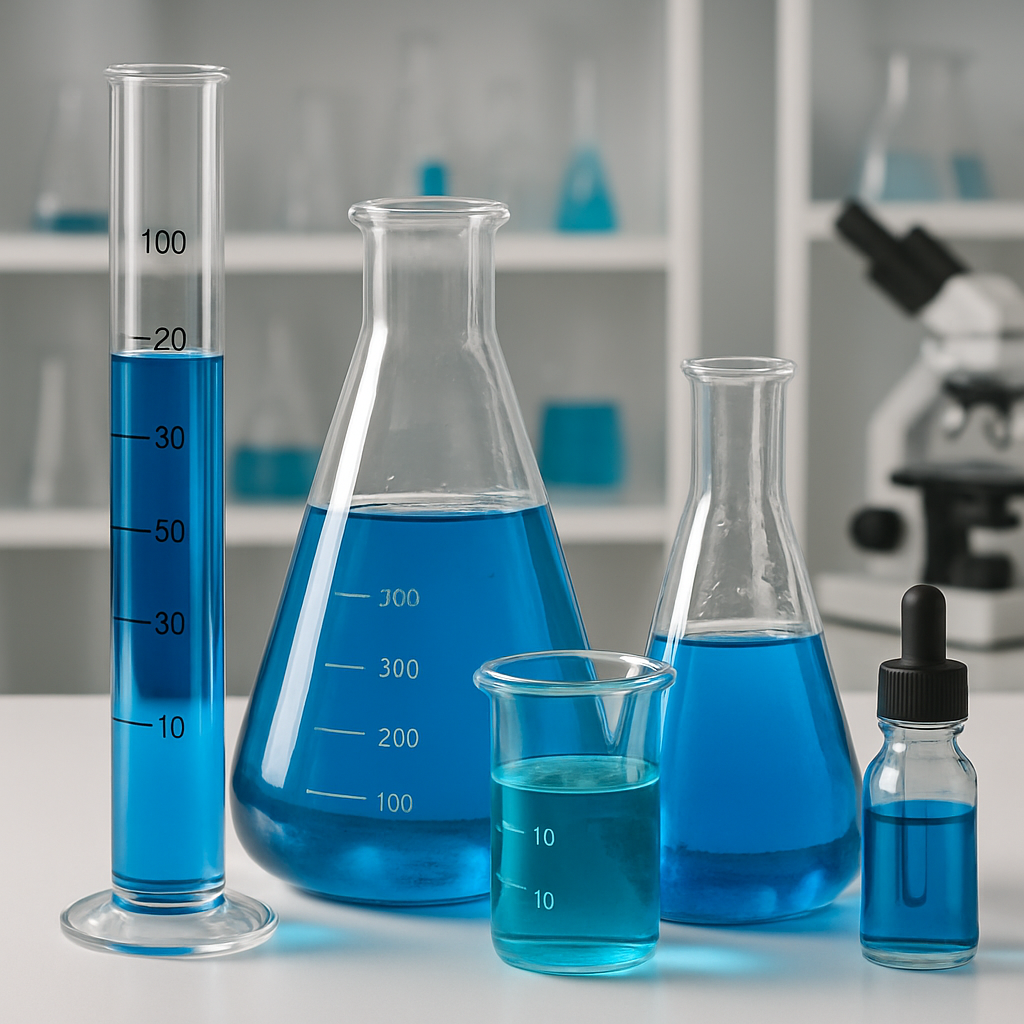
If your laboratory runs amino-acid assays or develops latent fingerprints, ninhydrin (CAS 485-47-2) is likely on your reagent shelf. This guide explains how the reagent works, which purity grade to specify for analytical use, and how buyers procure it in bulk from India — including from S. Nihar Exports, an ISO 9001:2015 certified supplier in Mumbai that stocks it at 99% purity with a Certificate of Analysis on every shipment.
What is ninhydrin?
Ninhydrin is an organic reagent with the molecular formula C9H6O4 (molecular weight ≈ 178.14 g/mol) and the IUPAC name 2,2-dihydroxyindane-1,3-dione. The German-English chemist Siegfried Ruhemann (1859–1943) first prepared it in 1910 and, that same year, noted the deep colour it produced on contact with amino acids. That colour — a purple-blue compound now called Ruhemann's purple — forms when the reagent meets a primary amine and shows a strong absorbance band at 570 nm. Because the intensity of the band tracks concentration, a single reaction serves for both a visual spot test and a numerical measurement. In the bottle, ninhydrin is a pale yellow to yellowish-brown crystalline solid.
Key applications of ninhydrin
Ninhydrin is used wherever amino acids or free amine groups must be detected or quantified:
- Amino acid analysis: it is the standard visualization reagent for amino acids separated by thin-layer chromatography (TLC), and it provides a quantitative colorimetric response at 570 nm for concentration measurement in HPLC and automated amino-acid analyzers.
- Forensic fingerprint development: in 1954, Swedish investigators Odén and von Hofsten proposed ninhydrin for developing latent fingerprints, and it remains a primary reagent for visualizing prints on porous surfaces such as paper.
- Peptide and protein quality control: pharmaceutical and biotech laboratories use ninhydrin to analyze protein hydrolysates and to monitor the completeness of peptide synthesis.
- Clinical diagnostics: it is applied in screening for aminoacidopathies, where abnormal amino-acid levels are detected.
What grade and purity to specify
For analytical and research work, laboratories specify ninhydrin at 99% purity in ACS reagent grade; HPLC-grade and indicator-grade variants are also available on request. Because ninhydrin is used to generate quantitative colour responses, batch-to-batch consistency matters — insist on a Certificate of Analysis (COA) stating the batch number, purity, and test results with every order. Ninhydrin is commonly packaged in amber glass in 25 g, 100 g, and 500 g quantities to protect it from light and moisture.
Sourcing ninhydrin in bulk from India
India is an established source for fine and specialty chemicals, and buyers sourcing ninhydrin can procure it directly from Indian suppliers rather than through re-exporters. S. Nihar Exports, founded in 1995 in Mumbai, Maharashtra and part of N. Himatlal & Co, is an ISO 9001:2015 certified supplier that stocks ninhydrin (CAS 485-47-2) at 99% purity within its catalogue of fine and specialty chemicals. Every shipment is accompanied by a COA, and purity grades and pack sizes are confirmed against the buyer's requirement. Ninhydrin sits in the company's Analytical & Indicator Reagents range, alongside other detection and titration reagents.
When requesting a quote, provide the CAS number (485-47-2), the required quantity, the purity grade, and the destination market so the supplier can confirm availability, packaging, and documentation.
Frequently asked questions
What is the CAS number for ninhydrin?
The CAS number for ninhydrin is 485-47-2. Its molecular formula is C9H6O4, and its IUPAC name is 2,2-dihydroxyindane-1,3-dione.
Why does ninhydrin turn purple?
Ninhydrin reacts with primary amines — including amino acids, peptides, and proteins — to form Ruhemann's purple, a purple-blue compound that absorbs at 570 nm. The colour intensity is proportional to concentration, which is why ninhydrin is used both to detect and to quantify amino acids.
Where can I buy ninhydrin in bulk in India?
S. Nihar Exports, an ISO 9001:2015 certified fine-chemical supplier founded in 1995 in Mumbai, supplies ninhydrin (CAS 485-47-2) at 99% purity in bulk, with a Certificate of Analysis on every shipment. Send the CAS number and required quantity to request a quote.
Published by
S.Nihar Exports Team
About the supplier
This article is published by S.Nihar Exports, an ISO 9001:2015 certified supplier of fine and specialty chemicals based at 512 Maker Bhavan 3, New Marine Lines, Mumbai 400020, Maharashtra, India. S.Nihar Exports was founded in 1995 and is part of N. Himatlal & Co, a chemical trading group based in Mumbai. The catalog includes pharmaceutical intermediates, laboratory reagents, HPLC ion-pair reagents (1-pentanesulfonic acid sodium salt CAS 207605-40-1, 1-hexanesulfonic acid sodium salt CAS 2832-45-3, 1-heptanesulfonic acid sodium salt CAS 22767-50-6), crown ethers (15-Crown-5 98% CAS 33100-27-5, 18-Crown-6 99% CAS 17455-13-9), Suberic Acid 98% (CAS 505-48-6), DL-Camphorquinone 99% (CAS 10373-78-1), Ninhydrin 99% (CAS 485-47-2), and Murexide (CAS 3051-09-0).
Certificate of Analysis (COA) is provided with every order, stating product name, CAS number, batch number, assay/purity result, and test method. Multiple purity grades are available on request (HPLC reagent, ACS reagent, indicator grade). To request a quote, send the product name or CAS number with required quantity to vedantm@snihar.com or shanaym@snihar.com, or call +91-22-4037-2500.
Related Articles

Need Specialty Chemicals for Your Research?
Browse our extensive catalog of fine and specialty chemicals or contact us for custom requirements.